

Economics is not accounting. Its unique framework asks how society can best use its scarce real resources eg people, land, capital, water etc. That question is not separate from the ‘for whom’ question ie ‘who should have the spending power that determines what is produced.
It is far easier for economists to run a mile from the ‘for whom’ question and just concentrate on making markets more competitive so that goods and services are produced ‘efficiently’. We end up with an economy geared to meet the needs of the wealthy while impoverishing the poor.
Value judgements should be made around the appropriate distribution of income and wealth but are left by default to be whatever emerges as the status quo.
This substack is based on a PIE commentary Does distribution matter in macroeconomics? It draws on the alarming proof of widening of the wealth distribution- not just the rich getting richer but the poor losing assets leaving many now with negative wealth.
With a background teaching public economics and public policy, I don’t understand why distributional issues are rarely talked about in macroeconomics. Distributional equity and economic efficiency are inextricably connected and co-created with economic activity and government policy.
Chasing more efficient outcomes (e.g. with competition policies) and lower fiscal ratios by cutting government spending (e.g. on critical public goods) while ignoring, or making the distribution worse, is very dangerous; not only for social cohesion but also for the damaging reduction in allocative efficiency in the use of our scarce real resources. So yes, distribution matters.
What is our default position?
This graphic provided by Dr Ganesh Ahirao,[depicts New Zealand’s highly unequal net wealth distribution in 2024.[ The top one percent (around 20,000 households) owns $183 billion or $9m each, while at the other extreme end, red bars are below the axis i.e. the poorest have negative wealth, they are in debt.
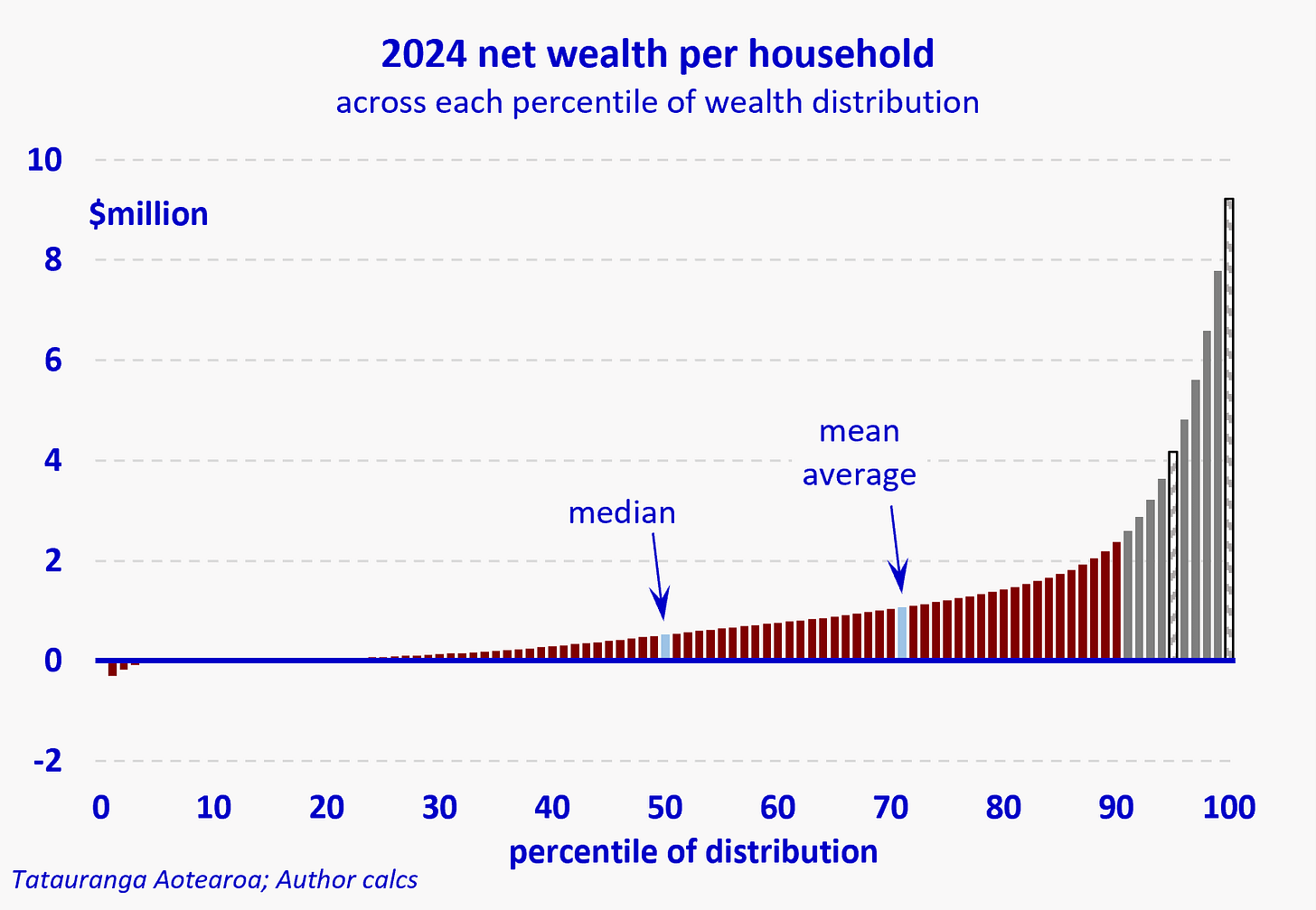
Total household net worth is $2,067 billion. Of this the bottom half (around 1 million households) owned $138 billion or just 6.7%. The top half have $1,929 billion, a wildly disproportionate share of 93.3%.
Worryingly, Dr Ahirao reports that in the nine years between 2015 and 2024, the lowest 10% (around 200,000 households) lost $6.3bn or $31,640 per household while the highest 10% (200,000 household) improved their net wealth by $455bn or $2.3m each.
Rather than any ‘trickle down’, this alarming widening of the wealth distribution indicates a substantial pulling away of the top from the bottom.
While some may prefer to focus reducing poverty while celebrating wealth creation, the top and the bottom are inter-connected, with compounding wealth at the top directly linked to the compounding debt, erosion of assets and loss of net worth at the bottom.
Unless consciously addressed, the substantial growth of inequality in the last 9 years will continue with all its adverse implications for achieving an economically efficient and just society.
But whose job is it to talk about distribution? I offer these thoughts through the lens of the insightful, but sadly neglected discipline of public economics where principles of equity and efficiency are equally important, and public goods are understood and valued as vitally necessary for the efficient operation of the economy.
What does theory say- bear with me here.
When resources of land, labour and capital are fully employed, a simple Production Possibility Frontier (PPF) illustrates that an infinite array of mixes of efficiently produced final goods is possible. If the economy is operating inside the PPF, more goods can be produced with given resources, so being inside, like at point D, (e.g. a recession or depression) is clearly economically inefficient. This particularly economic way of thinking is valuable because it abstracts from the question of money and focuses on real resource use.
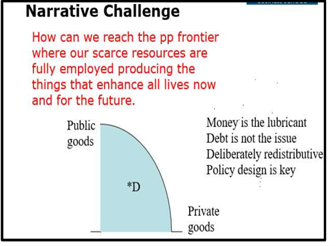
Once at the frontier, having more of one good has an opportunity cost i.e. the sacrifice is less production of the other. Along the PPF each point is ‘Pareto Efficient’ i.e. there is no reallocation of resources that can make one person better off without harming another.
The PPF illustrated has two classes of goods, collective goods or public goods, taken here as those not sold in markets, and private goods i.e. those sold in markets.
Some examples of public goods are state-funded health, education, social insurance, social housing, transport, environmental protection, creative activities, infrastructure and the legal system.
Which Pareto efficient point is ‘best’ of all the efficient points on the arc of the PPF? In a market economy the answer depends on who has the spending power i.e. the distribution of income (and power) will determine whose preferences are met.
Suppose the distribution is highly unequal and is at a point close to the private good end of the PPF arc. The preferences of the rich, who depend less on public goods, will favour private goods such as high-end housing, private insurance, high class restaurants, yachts, helicopter pads etc. There is likely to be much poverty and homelessness even if the point is ‘Pareto efficient.’
Here is the key insight from this simple model: Change the distribution, more for the poor and less for the rich, and there will be a different mix of goods in the Pareto efficient outcome. Which efficient point on the frontier is ‘best’ requires having the ‘best’ distribution.’ That is, value judgements are required.
How leaky is the bucket?
But suppose the income can only be transferred from Rich to Poor in a leaky bucket. The idea is that taxing the rich incentivises them to work/produce less, while giving to the poor creates an incentive for them to work less. The economy falls inside the production frontier as the economy shrinks, long before equality is achieved.
The left and the right disagree vehemently about how leaky this bucket is. For the right it is very leaky indeed and justifies inaction on taxing the wealthy. For the left any leaks are minor, however wider factors are also important such as union power in setting decent wages. Distributional issues are complex. It is no wonder that economists assume either the status quo distribution is OK or that redistribution is someone else’s problem.
It is fair to say that distributional analysis in current macro policy is absent. I searched the 2026 PREFU in vain for words like equity, poverty, distribution, hardship, costs or mention of the risks of unemployment, more ill health and social dysfunction. Yes, the budget itself is supposed to report on child poverty, but the 2026 BEFU Child Poverty report fell far short of providing a distributional analysis of why child poverty is growing and how widening inequality should be addressed. It was a joke.
Instead, macro goals have concentrated on the accountant’s vision of balancing the books, reducing the role of the state and reducing debt.
What is distributional fairness today?
The idea of fairness is values driven and at very least requires both horizontal and vertical equity:
Horizontal equity, or treating equals equally, seems likely to be seen as fair by most people, but it is often contentious in practice. For example, the recent decision to increase social housing rents from 25% of income to 30% of income next April was justified on horizontal equity grounds. In a perversion of the concept, it says poor who have social housing must be treated as equally as badly as others who are also poor.
Vertical equity requires a fair sharing of resources among unequals and is contentious, It is not the same thing as equality. It reflects a political philosophy. The current government’s implicit narrative on inequality is that the status quo is fair because they believe excessive wealth accumulation at the top reflects the rewards of entrepreneurial effort and hard work. Excessive poverty is tolerated in this ideology because it is believed necessary to provide a needed work incentive. Evidence suggests these beliefs are false but are part of the narrative.
How the top and the bottom are interconnected
The accumulation at the top and growing hardship at the bottom of the income and wealth distribution are connected. Rent paid by a struggling household becomes income for a property owner; interest paid by a borrower becomes income for a lender; low minimum wages leave workers struggling while helping to build profits and wealth for owners. The hardship at the bottom sustains the accumulation at the top, at least until the music stops.
The current narrative praises saving which only the well-off can do, while the poor are criticised for borrowing, even as their inadequate incomes force them into debt. Property owners are applauded for accumulating houses while tenants pay them rents that leave no opportunity to save.
Those whose businesses depend on low-paid labour are celebrated for their success, while their workers are trapped by the ideology that says welfare is only for the poor.
Tax and welfare systems based on this narrative deepens this divide. Wealth owners can accumulate millions in untaxed capital gains, while people on low incomes can lose most of each additional dollar earned through tax and the withdrawal of assistance from very low fixed thresholds of income. The vicious effective marginal tax rates of poorly designed punitive overlapping abatements make a lie of the dogma that work is the only route out of poverty
Whose job is it to monitor distribution
While there are many excellent NGO reports detailing the effects of inequality and poverty, tackling the growing income and wealth divide must become a central task of macroeconomic policy. We need to ask not only how much the economy produces, but who receives the gains, who bears the costs, and how the rules governing wages, housing, credit and taxation connect prosperity at the top with insecurity at the bottom.
New Zealand is regarded well internationally for its transparent accounting for the state, but a strong reporting on the state of the distribution of wealth and income is absent. Each macro-policy should be required to have a full analysis of its distributional impact.
We need a new narrative
Fundamentally we need a new narrative if we are to have a much more optimal allocation of our scarce resources. I suggest it should fall to macroeconomists to provide leadership here by shifting the dialogue from narrow accounting measures to the real economy and the distribution of wealth and income.
We are well inside the PP Frontier described earlier, and recent macro policy to address the deficit by cutting the government sector is poor economic policy: the resulting unemployment constrains our potential and ironically makes the deficit worse, while the emphasis on private goods for the really wealthy diverts our scarce resources into luxury conspicuous consumption.
Macro policy must lean against the characterisation of public goods as ‘bad’ because they increase the size of the state, while private goods are ‘good’ because they are not paid for out of taxes.
Public goods have enormous potential to affect the overall distribution and to greatly enhance the living standards of all. Their chief characteristic is that left to the private sector we would get very few of them. And there would be little to cushion downturns when confidence and investment shrinks.
A further insight from public economics is that as technology makes private goods far less labour intensive to produce, the excess labour could potentially be diverted to labour intensive, highly valuable public good production. This is what an ageing population, environmental degradation, natural disasters and a society with much ill health and poverty cries out for. The task is to explain this to taxpayers as the silver lining to the AI displacement of labour: society will have to pay more tax, ie give up more of their spending on private goods.
Macroeconomists could start the ball rolling. They might seek to wean government off the obsession with fiscal ratios and harmful cuts, adopt a simple goal such as ‘reducing inequality’ and explain clearly why it matters not just for fairness but also for a healthy functioning and efficient economy.
“The budget deficits of recent years are a result of our weak economy, not the other way around. …That is why investing in decreasing inequality and increasing equality of opportunity makes sense not only for our economy, but also for our budget.
Economic weaknesses will lead to cutbacks in public investments—including those that help ameliorate inequality—and we reinforce the vicious circle upon which we have embarked....”Joseph Stiglitz
---------------------------------------------------------------------------------------------------
Excellent, Susan, thank you. What we’ve seen from this government is a blatant enactment of policies designed around punishing the “lazy”poor for not working hard enough or smart enough, and rewarding the well off for their (assumed) hard/smart work which has already brought them wealth.
Excellent. Please send as briefing to the incoming government